Making More Jam
Thoughts on series 5 and beyond

Happy Easter! I’ve been trawling through the responses to the latest More Jam Tomorrow survey – it’ll be open for the next few weeks if you still want to contribute. MJT is listener-funded and ad-free, so I am not in the business of trying to extract your data, only your opinions.
Generally I agree with you about which episodes worked best and which fell short. MI5 was, on reflection, a poor choice: its secretive nature meant I was always going to struggle to find contemporary audio. The other problem is that a lot of people have written about it, cleared the book with the government, and are never going to say anything further. MI5 is at once mysterious and over-exposed.
The sound quality on one of the British Guyana interviews wasn’t great and, again, there was too little historical audio. As Rod Westmaas told me TV came relatively late to Guyana, and while you can find Pathé news footage on YouTube it is strictly copyright. No, I don’t understand why YouTube can monetise it but I can’t use the sound for a free podcast. Such is copyright law. Still, I like occasionally tackling subjects that get very little attention in Britain, and Guyanese history is certainly one of those.
What listeners most enjoyed was Milton Keynes, with decimalisation and motorways running a close second and third. Popular MJTs/JTs, like Concorde and jabs, often riff on postwar innovations that have either become commonplace, changed or faded away. One listener remembered his dad driving him on the M1 shortly after it opened. We were the future once, as David Cameron famously told Tony Blair over the despatch box. I like to think, though, that MJT isn’t nostalgic: I try to be clear-eyed about the past – filthy, polluted, parochial, prejudiced and dull as it often was.
In the past few days I’ve been mulling over a quick MJT on the 1973 oil crisis, and will approach a couple of historians – there are not many – who have written about it from a domestic standpoint. Listeners want to hear more about schools and railways. I shall try to oblige, probably through the lens of either comprehensives or the National Curriculum and British Rail. Are you interested in the postwar ‘plate glass’ universities? I am, but then I went to two of them. One supporter made the very intriguing suggestion of dams and reservoirs. We touched upon this a little on JT Welsh Nationalism with the flooding of valleys, but I reckon there is a lot more to discover, especially given we need to build more of them.
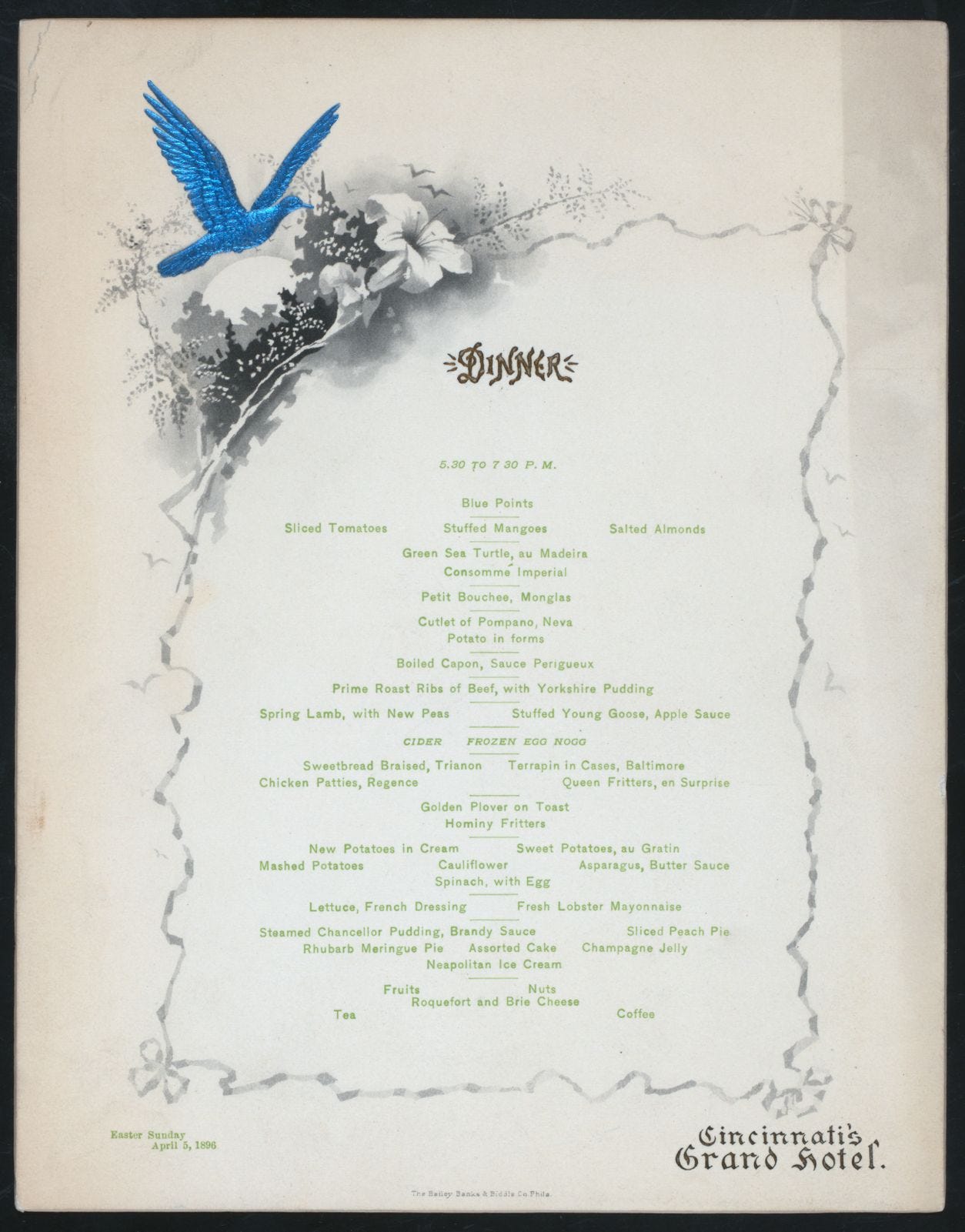
Easter Sunday menu at Grand Hotel, Cincinnati, 1896, exactly 130 years ago today. Sea turtle! But no chocolate. New York Public Library Digital Collections
Childbirth was another good suggestion, though I might have to restrain myself with the sound effects. So was the Clean Air Act and the smogs that preceded it. There’s also some demand for an episode on local newspapers, and the 1975 referendum and Britain’s accession to the European Community. I need to dig a little into the topic of summer holidays to uncover what might be surprising rather than merely soggy and nostalgic.
A couple of people requested dentistry and North Sea oil and gas, both of which are in the back catalogue (for the latter, search for Jam Tomorrow in your podcast app).
What do you think of nuclear power and NATO? The Windscale disaster is rarely talked about now, but had big ramifications. Other topics I’ve been pondering: drink-driving, skyscrapers (couldn’t persuade anyone to talk to me when I researched them a couple of years ago), the dole, Polish migration, national parks, Cyprus, Aden, the war in Korea.
I’m also thinking of running a few shorter, more niche episodes with just one interview. Smoking, say.
Thanks for listening! And special thanks to everyone who’s donated to keep More Jam Tomorrow going, as well as the listener who said: ‘I love the podcast and often share episodes with friends - please do keep making it!’ This is cheering.
Ros
More Jam Tomorrow is free, as is this Substack. If you like my work you can support it at Ko-fi.com.
If you're going to do 1973 oil crisis, linking it to 1977 establishment of Sustrans as CYCLEBAG and 1999 establishment of National Cycle Network would be good.